The Visibility Shift Most Businesses Are Still Ignoring, and It’s Costing Them
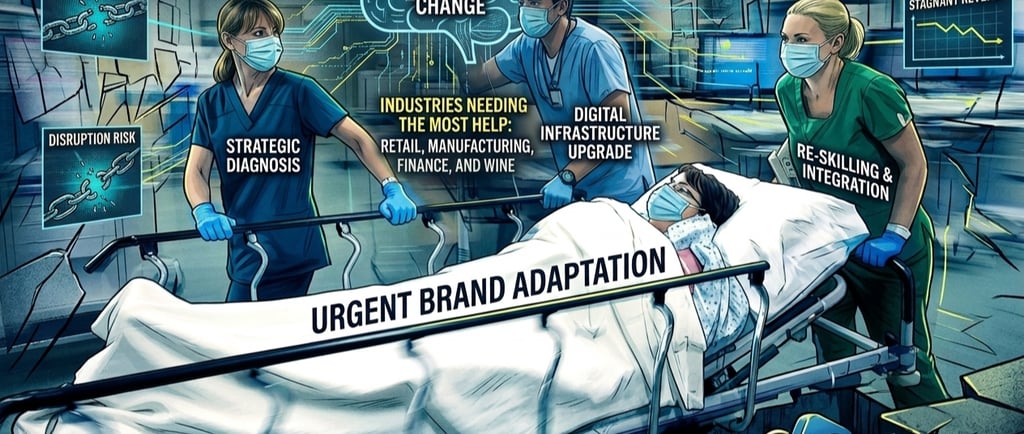
I've spent over 25 years helping businesses grow. Tech companies, consumer brands, nonprofits, startups. I know what a business looks like when it's thriving. And I know what it looks like when it's slowly bleeding out and refusing to acknowledge it.
I've been through industry ups and downs. I lived through the Dot Com era. I saw many good businesses crash and burn. Remember pets.com?
I believe we're seeing something similar with AI, but it feels more like 1450 than 1999. Like the movable type printing press, AI represents a fundamental, structural shift in how information is produced, distributed, and consumed. And with that shift comes something we're all familiar with: Survival of the fittest.
Many industries are already adapting and investing in the future, knowing AI is here to stay, but sadly, many others are still in denial.
Take the wine industry, for example.
I recently posted 2025 DTC data from the Paso Robles Wine Country Alliance in a local industry group. The numbers weren't great.
2025 Direct-to-Consumer (DTC) & Sales Trends
Revenue: Declined by 2.1% year-over-year.
Visitation: Tasting room traffic declined by 4.5%, resulting in a 6.2% decrease in tasting room sales.
Purchase Behavior: Conversion rates remained steady at approximately 63%.
Wine Clubs: New club signups slowed, down 13.5% [1]
Instead of engaging with the data, people met it with resistance, if not downright hostility. Certain members questioned my credibility, pushed back from every angle, insisted that AI has nothing to do with wine sales, and said that this is just a cyclical downturn that would correct itself.
"AI isn't going to get people drinking your wine. Getting out there in front of people, sharing your story and your product, being real and authentic - that will sell wine," said one local winery owner.
Really? Then why is there a proliferation of wine AI-RS apps available on the market? How is it that DRINKS’s patented AI models, called PAIR (i.e., Predictive AI Retailing), are bringing in an excess sale of 250,000 bottles a month?
Tastry is already working with wineries and retailers right here in Paso Robles, matching wines to individual consumer taste profiles using AI.
Denial isn't just a river in Egypt. I've seen this pattern before, and this isn’t unique to wine.
I see the same patterns in B2B SaaS companies that think product alone will carry them, in law firms that rely entirely on referrals, in financial advisors who haven’t adjusted to how younger investors research, and in real estate teams still operating like it’s 2019.
Different industries. Same behavior.
The Insider Trap
There's a paradox at the heart of every struggling industry: the people who know it best are often the least equipped to fix it. And, they don't think it's broken.
Not because they're not smart or because they don't make a great product. But because deep insider knowledge comes with deep insider blind spots.
When you've been in an industry for 20+ years, you've also absorbed its assumptions, mythologies, and the "this is just how we do things around here" mentality. The very experience that makes you credible inside the room makes it harder to see what someone standing outside the room can see clearly.
I saw this in the Dot Com era. The companies that insisted their business model was unique, that the rules of business didn't apply to them, and that critics just didn't understand their industry are the ones that didn't make it.
The ones that survived were the ones who got brutally honest about what wasn't working. They welcomed outside perspectives. They survived by having real business fundamentals such as clear unit economics and cash management, repeatable revenue models, customer focus, and the ability to change quickly rather than relying on vibes, product reviews, or unproven growth assumptions.
"Our Industry Is Different"
Every industry thinks it's different. Wine thinks it's different because it's emotional, experiential, and deeply personal. Tech thinks it’s different because it moves fast. Professional services think they’re different because they’re relationship-driven. Real estate thinks it’s different because it’s local.
They’re all saying the same thing in different ways. Winery owners believe they're in a generational wine recession that doesn't compare to anything else. They're wrong.
Herein lies the problem: if an industry thinks it's the only one with problems, then it stops looking for solutions outside of itself.
It keeps recycling the same thinking, the same strategies, and the same conversations that created the problem in the first place. And while it’s busy protecting its identity, the market moves on without it.
The rules of business and demographics haven’t changed. Businesses still need to understand their numbers, adapt to shifts in behavior and generations, and meet customers where they are. The industries that survive aren’t the ones that insist they’re different. They’re the ones willing to learn from what’s already working elsewhere and apply it faster.
Tech thought it was different because it was moving too fast for traditional business rules to apply. Real estate thought it was different right up until 2008.
Here's the truth: every industry has its own culture, its own language, its own nuances. And every industry still has to follow the same fundamental rules of business. Cash flow. Customer retention. Operational efficiency. Visibility to new buyers.
Last I checked, passion and good vibes don't pay the bills.
When numbers are down, that's not a vibe problem. That's a business problem. What makes an industry so "different "is seemingly its complete denial that change needs to happen. Wishing that 15-20% of your competitors would disappear because of market oversaturation, while not fixing your mess, isn't the answer.
The Visibility Shift Nobody Wants to Talk About
Here's where it gets uncomfortable for a lot of traditional industry insiders: The way buyers find products is changing FAST.
A growing number of consumers are starting their search on AI engines — ChatGPT, Perplexity, Claude, and Google AI. They're asking questions like "What's a good Paso Robles Mourvèdre?" or "What wineries should I visit in Paso Robles?"
If your winery isn't showing up in those answers, you're invisible to an entire generation of buyers who will never walk through your tasting room door. Not because they don't want to. Because they never found you.
The same is true for a law firm when someone asks, “Who’s the best estate attorney near me?” For a financial advisor, when someone asks, “Who helps with retirement planning for business owners?” Or a SaaS company, when someone asks, "What's the best tech stack for my digital marketing initiatives?"
If you’re not showing up in those answers, you’re not in the running.
I checked three major AI engines for a specific Paso Robles winery during that conversation. It wasn't showing up on ChatGPT, Claude, or Perplexity. Only on Google AI. That's not a wine problem. That's a visibility problem. And it’s happening across industries.
And not just that, it's a mindset problem, and it's fixable.
I get that the human element absolutely matters in wine. It's the very foundation of wine and the wine tasting and drinking experience, but from a marketing and visibility perspective, there's definitely a shift that must account for technology, too.
What Resistance Actually Costs
The saddest part of the conversation I described earlier wasn't the pushback. Pushback is healthy. The debate is how industries get smarter.
The saddest part is the missed opportunity and the fact that good businesses would rather cut their nose off despite their face and fall behind. Every time an industry closes ranks against outside expertise, it pays a price. Not immediately, but definitely eventually.
The businesses that make it through this downturn won't be the ones with the best vibes or the most passionate owners. They won't even be the ones with the best products. They'll be the ones who were willing to look honestly at what wasn't working, welcome perspectives they hadn't considered, and adapt before they were forced to.
And the messenger? The outsider with a different perspective and twenty-five years of experience across industries?
They might just be the ally you didn't know you needed.
Want to see where you’re NOT showing up—and what it’s costing you? Takes 2 minutes: https://kellyleereeves.com/geo-visibility-quiz
LET'S CONNECT!
Contact
Join my email list to stay updated on the latest news, receive exclusive offers, or get access to profit-building content.
hello@kellyreeves.com
+1-805-539-2333
© 2026. KLR Communications, LLC All rights reserved.
AI transparency disclaimer: Some content and images on this website were edited or enhanced with the assistance of AI. The strategies, experience, perspectives, and client results I share are my own professional expertise based on 25+ years of real-world experience.