PR Is The New Growth Hack In The Age Of AI.


PR is back, baby — and I couldn’t be happier!
I founded a tech PR agency in 2002. It was a time when earned media was easy to get and, for brands that wanted to create broader awareness, it reigned supreme.
Coverage in a top-tier outlet didn’t just build credibility; it drove real awareness, opened doors, and positioned brands as industry leaders and founders as go-to experts.
For companies trying to stand out in crowded markets, PR wasn’t just nice-to-have, it was a must-have.
Then came SEO…
As Google became the default gateway to the internet, the rules of visibility changed. Suddenly, brands weren’t chasing journalists; they were chasing algorithms.
Press hits took a backseat while keyword-stuffed blogs, backlinks, and endless “Top 10” listicles started running the show. SEO became a $75 billion industry, and PR was often treated as the redheaded stepchild, its true value overlooked.
Fast forward to today. With AI reshaping how people search, consume, and trust information, PR is no longer taking a backseat in the marketing station wagon. It’s reestablishing itself as the most powerful growth lever a brand can pull.
What happened to PR?
Over the past few years, traditional PR as we know it has suffered a slow and painful death. In the last decade, the number of full-time journalists and reporters in the U.S. declined by more than 50%, while the number of national and regional news media outlets fell by over 30%. (PR Week)
We now live in a society where fake news, headline snippets, and memes compete with facts. No one knows what or whom they can trust anymore.
Brands slashed PR budgets. PR firms and freelancers got 86'd instead of TikTok, Instagram, and influencers. PR’s perceived value dwindled.
Until now…
The rise of AI has completely disrupted how people discover information online. Tools like ChatGPT, Perplexity, and Google’s new Search Generative Experience (SGE) are rewriting the rules.
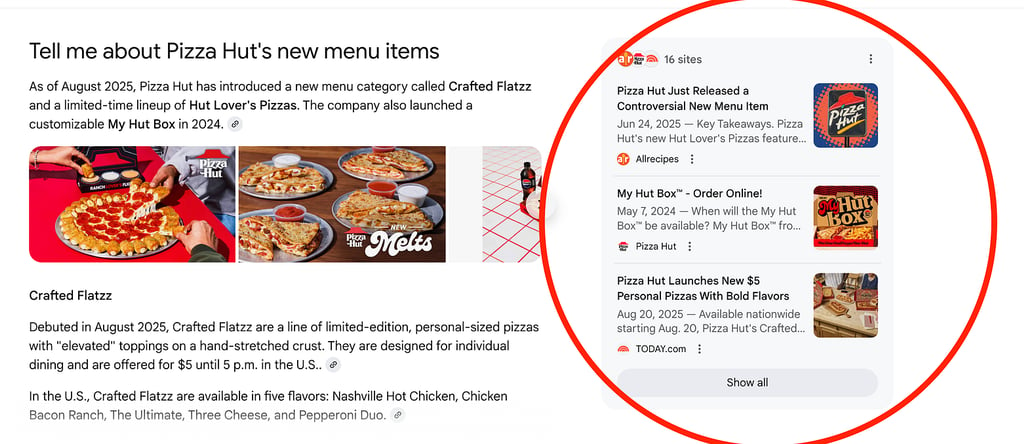
Instead of scrolling through a page full of blue links, users are now getting instant answers served up at the very top of search results in the form of structured content and press coverage.
That’s great for consumers, but devastating for websites and publishers that once depended on click-through traffic. We’re living through what many are calling the “traffic apocalypse.”
There’s been a massive shift from search engines being a referral service to an “answer engine,” with new AI Overviews that provide summarized answers directly on the search results page. This means users no longer need to click through to publishers’ websites, thus, causing a massive drop in traffic.
GEO Killed the SEO Star
Enter GEO, or Generative Engine Optimization. According to Google AI, GEO is “a digital marketing strategy focused on making content visible in AI-generated search results, such as those from Google’s AI Overviews and ChatGPT.”
Unlike traditional SEO that optimizes for keyword-driven search engines, GEO involves structuring and formatting content so that large language models (LLMs) can easily understand, cite, and summarize it to answer user queries.
The goal is to get your brand’s information recognized and referenced by these AI systems when users ask questions about relevant topics.
GEO isn’t about tricking search engines the way SEO does. It’s about structuring your content so it can be harvested, cited, and presented by AI chatbots.
That means:
Offering clear, concise answers instead of keyword-stuffed fluff
Using lists, bullets, FAQs, and comparison tables instead of walls of text
Ensuring your brand is cited in trusted outlets like The New York Times, Business Insider, TechCrunch, or even Wikipedia.
The battle has officially shifted from keywords to mentions. Those AI summaries are fueled by press hits, credible outlets, and expert commentary.
If you don’t have a press footprint, they simply won’t show up in Chat and the summaries, where more and more people are getting their answers, recommendations, and content.
We are also seeing a surge in influencers chasing legacy media because they know what the PR pros have known all along: PR is the most valuable growth lever in the age of AI.
It’s Not Just PR
The secret sauce to making all this happen is copywriting, in addition to PR.
PR is a revenue driver that fuels authority, but concise, structured, and human-friendly copy is what makes your message “AI-friendly.” When copy is packaged into answers that bots love to grab and readers love to trust, media coverage isn’t just awareness anymore. It’s what that powers discovery, trust, and sales inside AI platforms.
But, for AI to actually see and use that coverage, it needs data it can understand.
This is where it gets nerdy. To get these copy + PR results, you need JSON-LD (JavaScript Object Notation for Linked Data). It is a way of writing information so machines (like Google, Bing, or AI tools) can understand it.
Think of it as a translator between human-readable web pages and machine-readable data. This “translation layer” turns your press hits, company info, and thought leadership into structured data that AI engines can grab instantly.
AI runs on data. The clearer, factual info you give it, the more likely it will use your content.
Think: PR = the content in the box. JSON-LD = the label on the box.
And, PR converts — like crazy. If you show up in an AI-generated summary, you’re automatically positioned as an authority. And authority equals conversions, which is why brands that scale back on press are making a huge mistake. They are essentially choosing invisibility in the AI economy. Trust us the new currency and press coverage help you build that trust and authority.
In sum…
From SEO to GEO: The battle has shifted from keywords to citations in AI.
PR as revenue driver: Press isn’t just awareness; it’s the fuel for discovery, trust, and sales.
PR converts: Visibility in AI answers equals authority. Authority equals conversion.
The risk: Brands cutting PR right now are risking invisibility.
PR coverage gets you into the system, but concise, structured, and human-friendly copy is what makes your message “AI-friendly” — packaged into answers that bots love to grab and readers love to trust.
PR isn’t just back from the dead. It’s dancing on SEO’s grave as the darling of visibility in today’s AI-driven internet.
If you’re a PR professional, your job now is to explain this shift to your clients, prospects, and peers with absolute clarity.
Because the brands that understand it will dominate, and the ones that don’t will quietly disappear from the conversation.
I’ve helped startups and founders generate over $500 million in revenue, become the go-to experts in their niche, and get seen at the top of the page. Want to join them? Contact me.
LET'S CONNECT!
Contact
Join my email list to stay updated on the latest news, receive exclusive offers, or get access to profit-building content.
hello@kellyreeves.com
+1-805-539-2333
© 2026. KLR Communications, LLC All rights reserved.
AI transparency disclaimer: Some content and images on this website were edited or enhanced with the assistance of AI. The strategies, experience, perspectives, and client results I share are my own professional expertise based on 25+ years of real-world experience.